
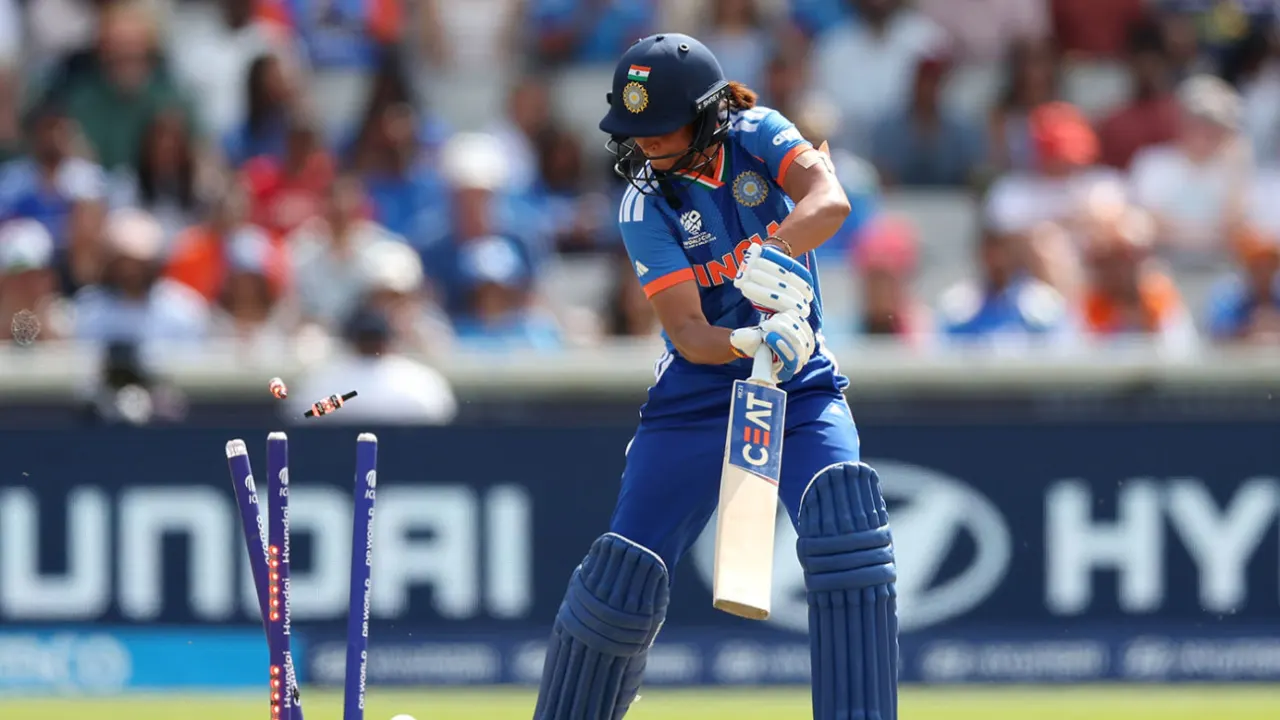


Former India pacer believes the captain should play her natural attacking game and stop focusing on rebuilding after wickets fall
Thank you for reading this post, don't forget to subscribe!India’s batting performance in the Women’s T20 World Cup 2026 has come under scrutiny, with former India fast bowler Shikha Pandey expressing concerns over captain Harmanpreet Kaur’s strike rate in the middle order. Pandey believes that Harmanpreet, one of India’s most experienced batters, would be more effective if she focused on playing her natural attacking game rather than trying to rebuild the innings after wickets fall.
Harmanpreet has scored 72 runs in the tournament so far at a strike rate of 109.09, batting at various positions between No. 4 and No. 6. According to Pandey, India’s captain could benefit from batting higher up the order, where she can play with greater freedom and put pressure on opposition bowlers from the outset.
Speaking on JioStar’s Game Plan, Pandey said Harmanpreet’s strike rate remains a concern for India’s middle order. She suggested that if an early wicket falls, India could consider promoting Harmanpreet to No. 4 while moving Jemimah Rodrigues down to No. 5. More importantly, Pandey emphasized that Harmanpreet should stop worrying about the wickets that have fallen and focus on playing her natural stroke-making game.
Pandey pointed out that when Harmanpreet settles at the crease, she becomes one of the most dangerous batters in world cricket. Her ability to dominate spin bowling, play powerful straight drives, and clear the deep midwicket boundary can significantly boost India’s scoring rate during the middle overs.
India’s batting struggles were evident in their match against South Africa, where Yastika Bhatia, Jemimah Rodrigues, and Harmanpreet managed just 51 runs from 49 balls combined. The team failed to build substantial partnerships, with the highest stand of the innings being only 33 runs. Frequent wickets disrupted momentum and exposed India’s middle-order vulnerabilities.
Former India batter Veda Krishnamurthy also weighed in on the batting order discussion, backing Jemimah Rodrigues to continue at No. 3. She stressed the importance of giving batters clearly defined roles rather than constantly shifting positions in the lineup.
According to Veda, confidence and clarity are crucial in T20 cricket. She noted that a string of low scores can cause a batter to overthink, while frequent changes in batting positions make preparation more difficult. She believes Rodrigues should be allowed to settle into a fixed role at No. 3 to maximize her impact.
While India’s batting has raised questions, Pandey praised young left-arm spinner Shree Charani for her outstanding performances in the tournament. Charani has emerged as one of India’s biggest positives, claiming 10 wickets in just three matches and forming an effective spin partnership with Deepti Sharma.
Pandey highlighted Charani’s excellent control, variations in pace, and ability to consistently attack the stumps. She particularly praised the dismissal of South Africa’s Annerie Dercksen, describing it as the ideal delivery for a left-arm spinner, pitching on off and middle stump before crashing into the stumps.
With the group stage nearing its conclusion, India face a must-win encounter against Bangladesh. The team may need victories in both of their remaining matches and could also have to rely on net run rate calculations to secure a place in the Women’s T20 World Cup 2026 semi-finals.
As India prepare for a crucial phase of the tournament, all eyes will be on Harmanpreet Kaur and the middle order to deliver the performances needed to keep their World Cup campaign alive.


