
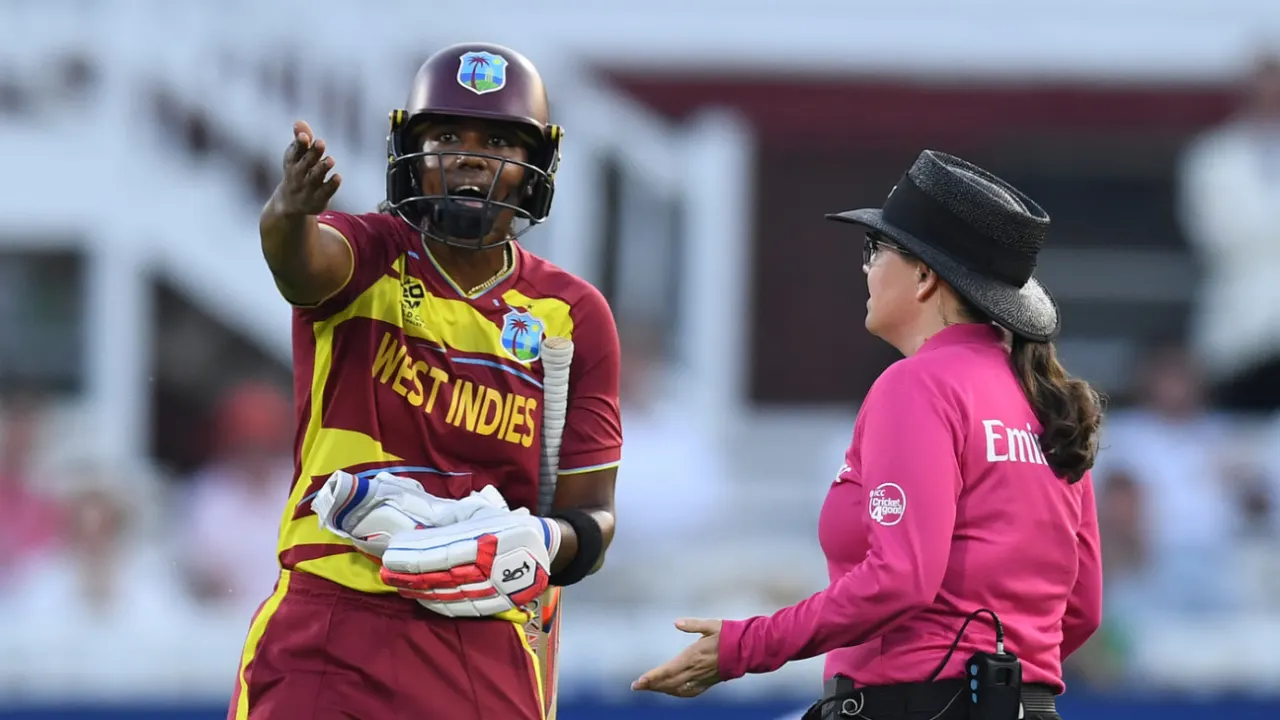


West Indies captain questions caught-behind verdict despite visible gap between bat and ball, but says she must respect the umpire’s decision
Thank you for reading this post, don't forget to subscribe!West Indies captain Hayley Matthews expressed her frustration after a controversial DRS decision during her team’s 38-run loss to England in the ICC Women’s T20 World Cup 2026 at Lord’s. Matthews was given out caught behind despite television replays appearing to show a clear gap between her bat and the ball, a decision that proved to be one of the most debated moments of the tournament.
The incident occurred in the fourth over of West Indies’ chase when Matthews attempted a cut shot against England spinner Linsey Smith. Wicketkeeper Amy Jones immediately appealed for a catch behind, but on-field umpire N Janani initially turned down the appeal. England stand-in captain Charlie Dean opted for a review, sending the decision upstairs.
During the review process, video replays failed to show any obvious contact between bat and ball. However, UltraEdge technology detected a spike at the moment the ball passed the bat. Despite the front-on camera angle seemingly showing a visible gap, TV umpire Nimali Perera ruled that there was sufficient evidence to overturn the original decision and declared Matthews out.
The dismissal sparked visible frustration from the West Indies skipper. Matthews engaged in discussions with the on-field umpires before leaving the field and later reviewed the footage from the dugout alongside head coach Shane Deitz. She was also seen speaking with reserve umpire Kerrin Klaaste after the incident.
Speaking after the match, Matthews maintained that she did not believe she had edged the ball. She explained that while she heard a sound during the shot, she believed it may have come from her bat handle rather than the ball making contact with the bat.
“When I cut at the ball, I heard something which I thought was probably my bat handle or something like that. I certainly felt like I was far away from the ball,” Matthews said during the post-match press conference.
The West Indies captain acknowledged that the television umpire had to rely on the available technology but reiterated her belief that the visual evidence suggested no contact had been made.
“I felt like you could have seen a clear gap between bat and ball, but at the same time, the TV umpire has got to work with the technology that there is. She saw a spike, and at the end of the day, I’m going to have to respect that,” Matthews added.
The incident has reignited discussions surrounding edge-detection technology in cricket. Similar debates emerged during the 2025-26 Men’s Ashes series, where the reliability of Snicko and UltraEdge systems came under scrutiny following several contentious decisions.
Matthews has endured a challenging run with the bat since scoring 48 in West Indies’ opening victory over New Zealand. Her subsequent scores of 14 against Scotland, 17 against Sri Lanka, and 14 against England have reflected a dip in form at a crucial stage of the tournament.
Despite her struggles, Matthews remains encouraged by the broader contributions within the West Indies squad. She highlighted the team’s ability to remain competitive even when key players like herself and Deandra Dottin have not performed at their usual level.
“I need to get some runs. Deandra probably feels like she hasn’t been at her best either, and yet we’re still winning games and competing. It shows we’ve got a lot more people that we’re relying on now,” Matthews said.
West Indies currently sit second in Group 2 with three wins from four matches, behind table-toppers England, who have already secured a place in the semi-finals. A victory against Ireland in their final group-stage fixture will guarantee West Indies a spot in the last four. However, a defeat could leave their qualification hopes dependent on net run rate, with both New Zealand and Sri Lanka still in contention for a semi-final berth.


